Blockchain, Web3 Infrastructure, Digital Identity (DID/VC),
Beyond Finance: How Blockchain is Becoming a Lifeline in Iizuka City
25 Feb 2026
Introduction
As Japan enters the pivotal week of February 16, 2026—a period officially designated by the national government as the core of "Digital Year One"—the conversation around blockchain is undergoing a fundamental transformation. For years, the technology was synonymous with financial speculation and volatile crypto-assets. However, a landmark project in Fukuoka Prefecture is proving that blockchain’s most profound impact may not be in our wallets, but in our survival.
This article explores the Iizuka City DID/VC Disaster Prevention Demonstration Project, a world-first initiative that utilizes decentralized technology to modernize disaster response. We will delve into the technical infrastructure, the specific government support backing the initiative, the timeline for nationwide implementation, and what this paradigm shift means for the corporate and startup ecosystems in Japan.
The Initiative: "One VC, Two Values"
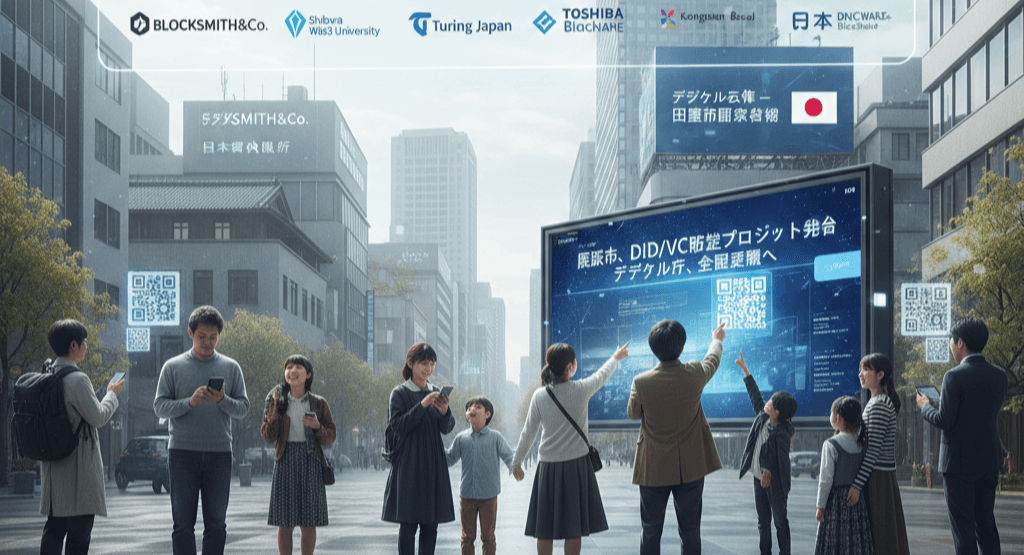
Iizuka City, which made history in 2021 as the first municipality in Japan to issue a "Blockchain Promotion Declaration," is currently the testing ground for a revolutionary disaster DX (Digital Transformation) system. The project is led by a four-company alliance—BLOCKSMITH&Co., Shibuya Web3 University, Turing Japan, and Kangaeru Bosai—under the Iizuka City FY2025 Advanced IT Demonstration Support Project.
The core of the initiative is the "One VC, Two Values" (One Verifiable Credential, Two Values) concept. It bridges the gap between daily life and emergency situations by using blockchain-based digital certificates.
Detailed Mechanics and Technology
In daily life, residents participate in "QAQA-BO," a gamified disaster prevention program accessible via the city’s official LINE account. Residents complete disaster quizzes to earn "Disaster Learning Certificates" issued as Verifiable Credentials (VCs).
When a natural disaster strikes, these same certificates instantly transform into a secure digital ID. At evacuation shelters, residents simply scan a QR code to complete the check-in process. This removes the need for paper forms and manual data entry, which often lead to bottlenecks and coordination failures during crises.
The project is technically significant because it utilizes two distinct blockchain infrastructures to test different scales of implementation:
IOTA: A public, leaderless distributed ledger favored for its high-speed, feeless transactions and suitability for global IoT standards.
Toshiba’s DNCWARE Blockchain+: A domestic enterprise-grade "consortium" blockchain designed for high security and compliance within the Japanese corporate environment.
Official Sources and Government Context
The project is more than a local trial; it is a key component of the Digital Agency’s "Priority Plan for the Realization of a Digital Society" and the broader "Digital Garden City Nation" vision championed by the Japanese Cabinet. This national strategy provides approximately 100 billion yen in grants to promote regional revitalization through high-tech implementation.
Current Stage and Achievement Target
As of February 2026, the initiative is in its Demonstration Experiment Stage. The timeline is structured in four critical steps:
December 2025 – March 2026: Active demonstration experiments and usability testing with citizen monitors and disaster experts.
May 2026: Analysis of results and compilation of a final report for the Ministry of Economy, Trade and Industry (METI) and the Digital Agency.
June 2026: Targeted launch date for the nationwide expansion of the model to Japan’s 1,741 municipalities.
What It Means for Corporates
For large corporations, the Iizuka City model represents a shift toward "Infrastructure as a Service" (IaaS) in the social sector.
Resilient BCP (Business Continuity Planning): Traditionally, corporate BCP depends on centralized servers. The use of Decentralized Identifiers (DID) means that employee safety data and mission-critical identity verification can remain functional even if a company’s central network is compromised or destroyed during an earthquake.
Compliance and Privacy: By utilizing international W3C standards and ISO-compliant platforms like Turing Certs, corporations can manage sensitive personnel data with full GDPR and Japanese privacy law alignment.
Cross-Sector Collaboration: The involvement of giants like Toshiba and Sega (via the QAQA-BO program) highlights a new trend: major firms providing the technical backbone for municipal social services.
What It Means for Startups
The success of disaster DX creates a massive "Middleware Explosion" for the startup ecosystem.
SaaS for the Public Sector: There is an urgent need for startups that can build the "Human Layer" of Web3—intuitive interfaces that allow non-technical citizens (including the elderly) to interact with the IOTA or Toshiba blockchains.
Capital and Grants: The move toward "Digital Year One" includes a tax overhaul (shifting crypto gains to a flat 20% rate) and the reclassification of digital assets under the Financial Instruments and Exchange Act (FIEA).This regulatory clarity makes it significantly easier for startups to secure venture capital and government subsidies for social-utility projects.
Global Scalability: Because the Iizuka model uses global standards like DID and VC, Japanese startups building these solutions have a direct "export path" to other disaster-prone regions in Asia and beyond.
Leading the Renaissance: Renesis Tech Japan
Navigating the complexities of Japan’s "Digital Year One" requires a partner who understands the intersection of cutting-edge tech, municipal policy, and the strict 2026 regulatory environment. Renesis Tech Japan is positioned as the premier consultation and execution partner for organizations looking to lead in this new era.
We provide a comprehensive, four-pillar approach to project success:
Discovery: We help you identify high-impact use cases within the Japanese digital ecosystem, aligning your goals with national policies like the Digital Garden City Nation vision.
Consultation: Our team provides technical and regulatory due diligence, ensuring your use of public chains (like IOTA) or consortium chains (like Toshiba DNCWARE) meets the latest FSA and FIEA standards.
Feasibility: We conduct utility studies to conceptualize frameworks and schemes that are sustainable, cost-effective, and designed for real-world social or corporate implementation.
Execution: From developing robust smart contracts and DIDs to building user-friendly mobile interfaces, our engineering teams provide full-lifecycle development and auditing to ensure your project is "institutional-grade" and secure.
The Iizuka City project is proof that Japan is no longer just talking about Web3; it is building it into the very fabric of its society. As we move toward the June 2026 nationwide rollout, the opportunity to build a more resilient and connected Japan is here.
Here is the video. Please watch it